INITIAL ASSESSMENT
 Personal Assessment of Management Skills (PAMS)™
Use this self-assessment instrument to get a profile of your level of competence on several important management skills.
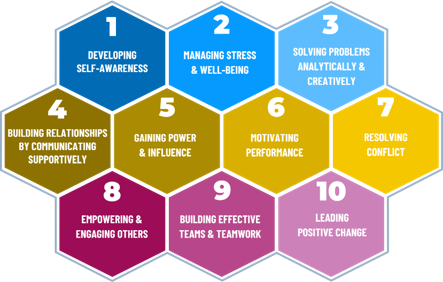
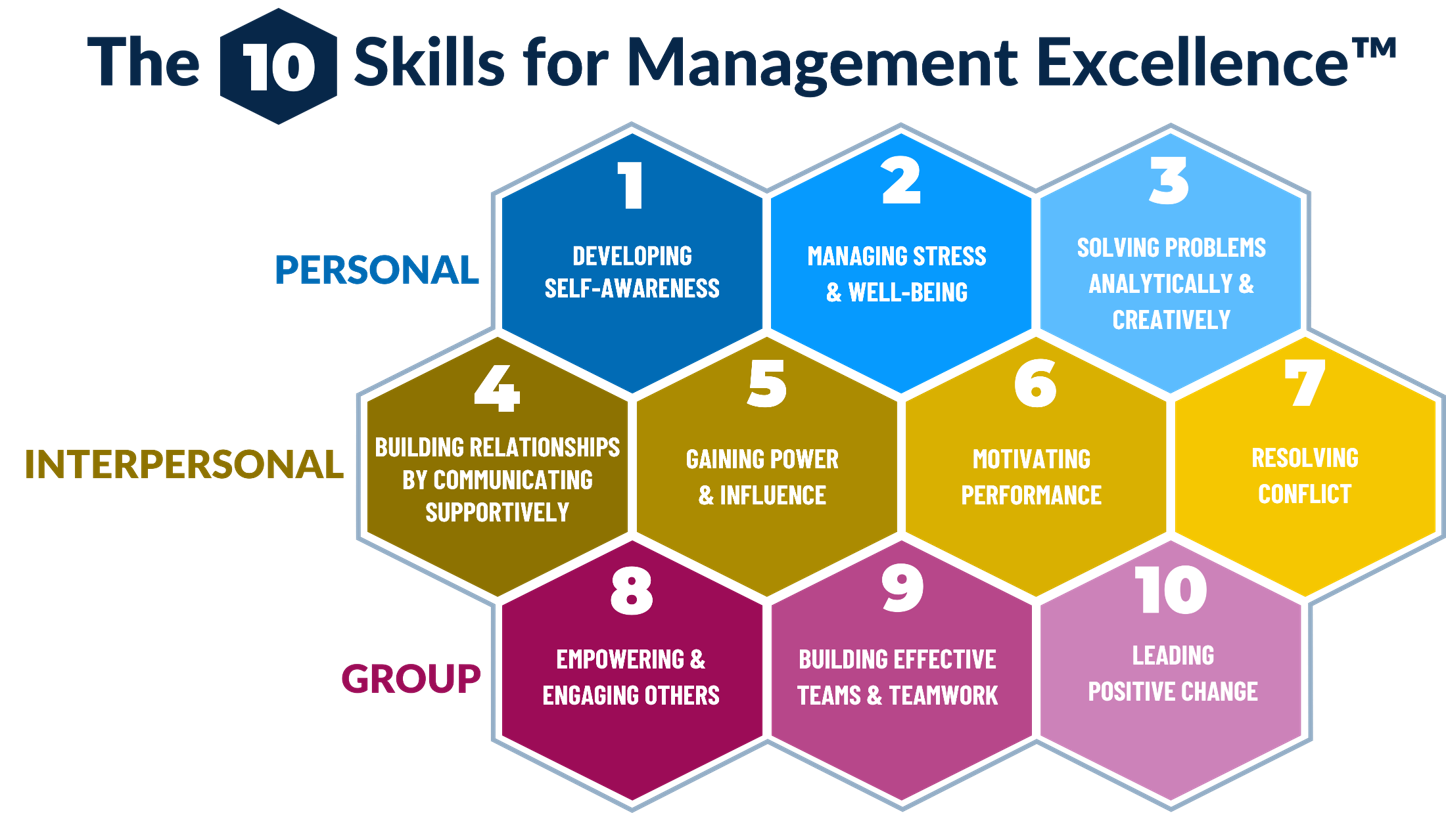
SKILL #1 – DEVELOPING SELF-AWARENESS
Self-Awareness Assessment (SAA)™
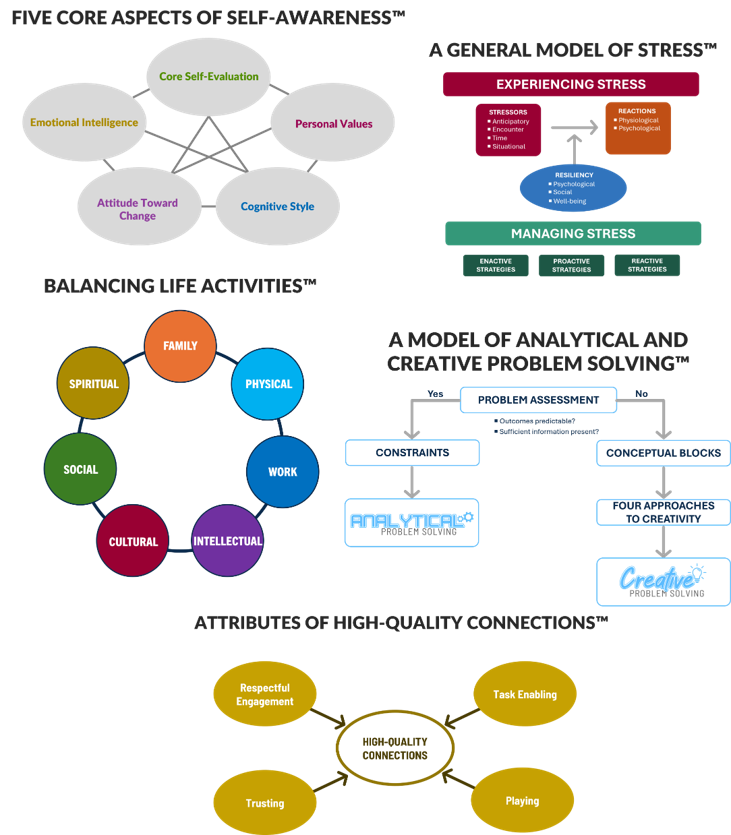
This self-assessment is designed to help you gain insights into yourself and the efforts you make to increase your self-awareness, so you can tailor your learning of personal, interpersonal and group/team skills to your specific needs.
SKILL #2 – MANAGING STRESS & WELL-BEING
Stress Management Assessment (SMA)™
This self-assessment is designed to help you understand how well you manage stress. It also provides insights into your overall well-being.
Time Management Assessment (TMA)™
This self-assessment helps you compare your current time management practices with a list of effective practices compiled from the work of experts on this subject.
Sources of Personal Stress (SPS)™
This self-assessment helps you to identify sources of personal stress and reflect on how to manage them.
SKILL #3 – SOLVING PROBLEMS ANALYTICALLY & CREATIVELY
Problem Solving, Creativity, and Innovation (PSCI)™
This self-assessment is designed to help you better understand how well you solve problems, use a creative perspective when appropriate, and foster creativity and innovation.
Creative Style Assessment (CSA)™
Research has identified four creative styles. These can be thought of as approaches to creativity. This self-assessment helps you identify your preferred style.
SKILL #4 – BUILDING RELATIONSHIPS BY COMMUNICATING SUPPORTIVELY
Communicating Supportively Assessment (CommSA)™
This self-assessment is designed to help you assess the extent to which you engage in supportive communication. In contrast to accurate communication, which refers to the content of what is communicated, supportive communication is the use of communication to improve interpersonal relations.
Communicating Styles Assessment (CStyles)™
This self-assessment provides insights into your preferred style of interpersonal communication.
SKILL #5 – GAINING POWER & INFLUENCE
Gaining Power and Influence Assessment (GPIA)™
This self-assessment helps you understand your proficiency with four closely related skills: gaining power, exercising influence, exercising authority, and resisting inappropriate influence.
Using Influence Strategies Assessment (UISA)™
The ability to influence others is a key component of effective social interaction. This self-assessment helps you identify your preferred approach to exercising influence.
SKILL #6 – MOTIVATING PERFORMANCE
Motivating Performance Competency Assessment (MPCA)™
This self-assessment is designed to help you assess how well you use proven motivation strategies to enhance the work performance of others.
Motivational Potential of Work Assessment (MPWA)™
This self-assessment helps you identify obstacles you are experiencing (or have experienced) that prevent you from achieving a high level of performance in a work setting.
SKILL #7 – RESOLVING CONFLICT
Resolving Conflict Competency Assessment (RCCA)™
This self-assessment is designed to help you better understand your preferred approaches to managing and resolving interpersonal conflict.
Approaches for Resolving Conflict Assessment (ARCA)™
This self-assessment will help you become more aware of how you typically respond to interpersonal conflict, setting the stage for learning how you can improve this critical management skill.
SKILL #8 – EMPOWERING & ENGAGING OTHERS
Effective Empowerment and Engagement (3E)™
This self-assessment is designed to help you understand how effectively you empower others and facilitate their feelings of engagement when you are serving in a supervisory role.
Personal Empowerment Assessment (PEA)™
This self-assessment helps you better understand the extent to which you are empowered in a particular role.
SKILL #9 – BUILDING EFFECTIVE TEAMS & TEAMWORK
Team Development Behaviors Assessment (TDBA)™
This self-assessment is designed to help you better understand the contributions you make to building effective teams and enabling teamwork.
SKILL #10 – LEADING POSITIVE CHANGE
Leading Positive Change Assessment (LPA)™
This self-assessment is designed to help you better understand how well you lead planned change initiatives within groups and organizations.