DOWNSIZING DONE RIGHT

The WAY downsizing occurs is far more important than the FACT that it occurs. Downsizing done wrong can set your culture and organization back years or even decades. Learn research-based best practices to effectively navigate change and successfully implement organizational downsizing.

Overview

Downsizing is, by far, the single most implemented organizational change strategy in the world. Unfortunately, downsizing is typically viewed by senior leadership as simply a cost-cutting initiative to reduce the expense line on the income statement in an attempt to generate greater bottom line results. Extensive research has demonstrated that there is a right way and wrong way to downsize that has significant long-term implications for the culture and performance of the organization.

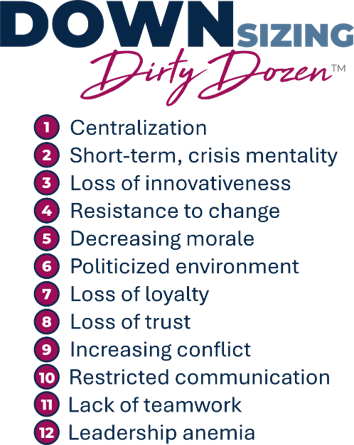
Most organizations downsize poorly by choosing a downsizing strategy that produces the Downsizing Dirty Dozen™. Cameron Institute can assist your organization to choose the correct, empirically-based downsizing strategy, and guide your leadership to implement it as part of an effective organization change strategy.
RESEARCH RESULTS OF DOWNSIZING DONE THE WRONG WAY

Absent an organized, research-backed, empirically-based system of evaluating the proper downsizing strategy, developing an effective downsizing plan, and implementing a downsizing initiative as part of a broader culture change, you can expect the results below based on research of thousands of organizations over the past several decades:

Fewer than half the companies that downsized in the last decade had short or long-term profit increases.

Less than 10 percent of downsizing firms reported improvements in product and service quality, innovation, and organizational climate.

Three years after downsizing, the market share prices of downsized companies were an average of 26 percent below the share prices of their competitors.

Almost all organizations that downsized—in the public sector and the private sector—experienced an emergence of the Downsizing Dirty Dozen™ as a result of downsizing.

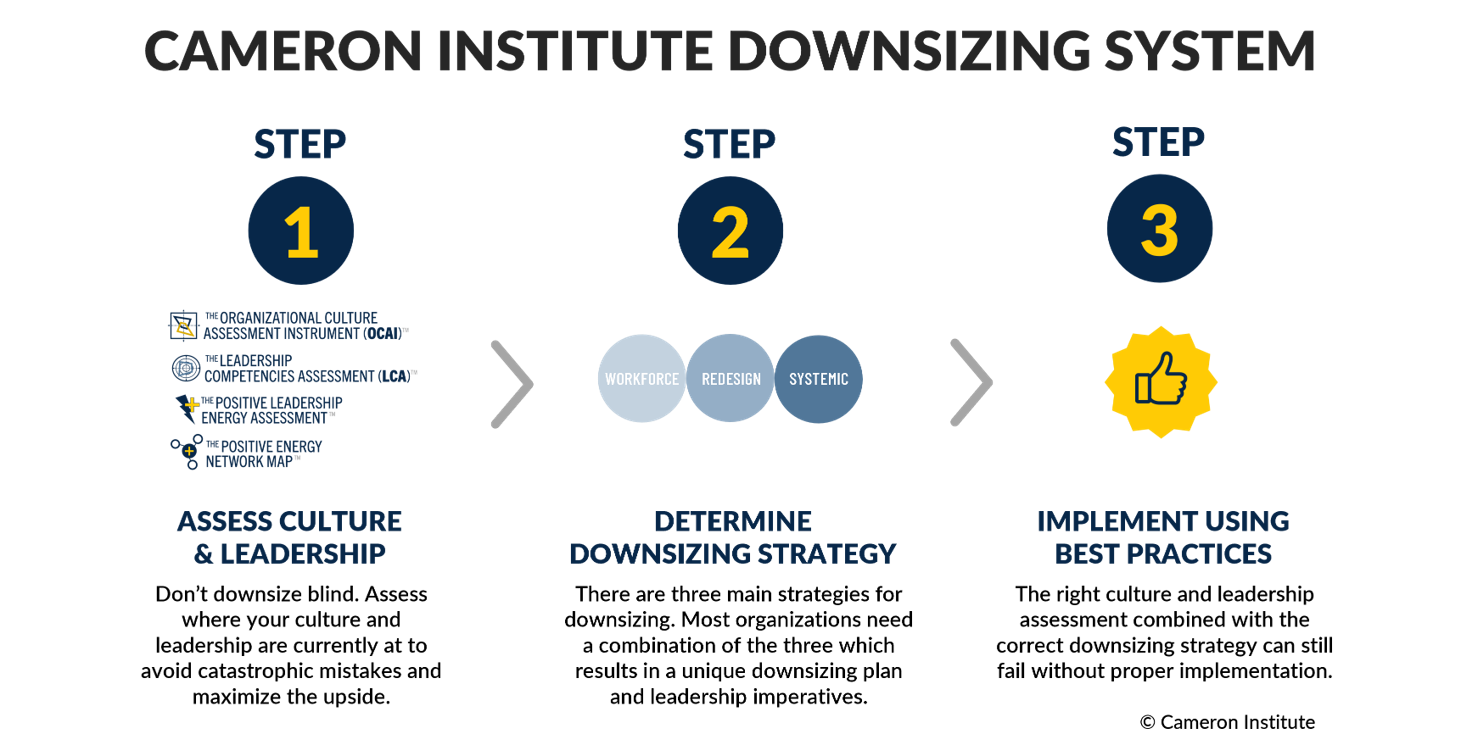
DOWNSIZING DONE RIGHT – CAMERON INSTITUTE RESEARCH-BACKED SYSTEM

downsizing

DOWNSIZING SYSTEM EMPIRICAL BASIS

Cameron, Kim S. (1998) “Strategic organizational downsizing: An extreme case.” Research in Organizational Behavior, 20: 185-229.

Cameron, Kim S, (1997) “Downsizing and the new work covenant.” Exchange, Spring, 7-9.

Cameron, Kim S., and Freeman, Sarah J. (1991) “Cultural congruence, strength, and type: Relationships to effectiveness.” Research in Organizational Development, 5: 23-58.

Cameron, Kim S., Freeman, Sarah J., and Mishra, Aneil K. (1991) “Best practices in white-collar downsizing: Managing contradictions.” Academy of Management Executive 5:57-73.

Cameron, Kim S. (1991) “Downsizing can be hazardous to your future.” H.R Magazine, May.

Cameron, Kim S. (1998) “The Role of Forgiveness in Organizational Downsizing.”

Cameron, Kim S. (1984) “The effectiveness of ineffectiveness.” Research in Organizational Behavior. 6: 235-285.

Cameron, Kim S. (1994) “Strategies for successful organizational downsizing.’ Human Resource Management Journal 33:189-212.

Cameron, Kim S. (1995) “Downsizing, quality, and performance.” In Robert E. Cole (ed.) The Death and Life of the American Quality Movement. New York: Oxford University Press. (pages 93-1 14).

Cameron, Kim S. (1997a) “Techniques for making organizations effective: Some popular approaches.” In Enhancing Organizational Performance: Issues, Evidence, and Techniques. Washington DC: National Research Council.

Cameron, Kim S. and Smart, John R. (1998) “Maintaining Effectiveness Amid Downsizing and Decline.” Research in Higher Education, (in press).

Cameron, Kim S., Freeman, Sarah J. and Mishra, Aneil K. (1993) “Downsizing and redesigning organizations,” ln George Huber and William Glick (eds) Organizational Change and Redesign. 19-63. New York: Oxford University Press.

Cameron, Kim S., Kim, Myung U., and Whetten, David A. (1987) “Organizational effects of decline and turbulence.” Administrative Science Quarterly. 32: 222-240.

Cameron, Kim S. and Whetten David A. (1983) Organizational Effectiveness: A Comparison of Multiple Models. New York: Academic Press.

Cameron, Kim S. and Whetten, David A. (1986) “Organizational effectiveness and quality: The second generation.” Higher Education: Handbook of Theory and Research, 11: 265-306.

Survivor’s Guilt And Survivor’s Envy: How Downsizing Impacts Those Who Stay—An Interview With Dr. Kim Cameron – Forbes.com, June 8, 2020

ASSESSMENTS

  • Based on The Competing Values Framework™, The Organizational Culture Assessment Instrument (OCAI)™ is the definitive instrument for measuring organizational culture. Developed over 40 years ago, the instrument has been used by more than 10,000 organizations and taken by 24 million+ respondents. Contact Cameron Institute today to set up your assessment.

  • Understand how the skills and competencies of your leaders align with your culture as part of evaluating the downsizing strategy your organization should pursue. The LCA™ can be administered to leaders online and is the quickest way to obtain a high-level snapshot of culture and leadership alignment.

  • The Positive Leadership Energy Assessment™ is a quick and simple way to evaluate positively energizing leaders in an organization (Owens et al., 2016). Employees rate their leader on five attributes using a 7-point Likert scale. Aggregating the responses of employees in a particular business unit or team provides a mean score. The instrument is very helpful when, as part of assessing culture and leadership in preparation for determining a downsizing strategy, an organization needs a quick way to determine the extent to which employees are being positively energized by their leader.

  • Knowing who the positive energizers and de-energizers are among your leadership ranks is a critical part of any successful organizational downsizing initiative. If an organization, for example, inadvertently selects some of its top positive energizers among its middle management ranks to be part of the downsizing initiative, the destabilizing effect on the culture of the organization will quickly invite the Downsizing Dirty Dozen™ and validate the adage that sometimes “the cure is worse than the disease.”

    The most sophisticated method for identifying positive energizers in an organization is by creating a Positive Energy Network Map™ which not only visually shows the leaders and individuals who have the most energizing connections, but also produces data and information to inventory the relative amount of energizing that is occurring in the organization. Making downsizing decisions absent this critical data and visibility can lead to catastrophic results in an organization. Contact Cameron Institute today to initiate this assessment.

WHAT IS THE NEXT STEP?

Scenario

Desired Result

Your organization underperformed last quarter or is about to miss targets this quarter and your board and the Street are demanding immediate action to cut expenses, including headcount, to improve bottom line performance.

Next Step

Connect with Cameron Institute to begin assessing your culture and leadership in preparation for determining the right downsizing strategy for your organization. Email [email protected] or click on the button below and send a message to our Cameron Institute team through our contact form.

Scenario

Desired Result

You previously created a downsizing plan with a deadline to implement it that has already been communicated to your board, and you just learned about Cameron Institute. You need a quick, independent, expert review of your plan and rapid guidance regarding the best practices for implementation.

Next Step

Connect with Cameron Institute ASAP.  Email [email protected] or click on the button below and send a message to our Cameron Institute team through our contact form.

CONNECT WITH CAMERON INSTITUTE

    © Copyright 2025 Cameron Institute